Apple seen in 'pole position' to control mobile Internet computing
The platform of the iPhone, iPod touch and iTunes has seen the fastest rate of adoption of any new technology in history, a new study has concluded.
Microsoft patches Office 2003 lockout bug
Microsoft has fixed a problem in Office 2003 that prevented the software from opening documents saved using its access control technology.
The company warned late Friday that Office 2003 would not be able to open documents that had been protected with its Rights Management Services (RMS) beyond that day until Microsoft issued an update, even if users were authorized to open the document.
Users also could not save documents with RMS, which is used to prevent sensitive documents from being opened by unauthorized users, among other functions.
The problem was caused by the expiration of an Information Rights Management (IRM) certificate. On Saturday, Microsoft released a hotfix, it wrote on its Office Sustained Engineering Team blog .
The problem affects Word 2003, Word 2003 Viewer, Excel 2003, Excel 2003 Viewer, PowerPoint 2003 and Outlook 2003. Office 2007 is not affected and neither is the Office 2010 beta, according to a Microsoft spokeswoman.
If the hotfix is not applied, users will see the warning: "Unexpected error occurred. Please try again later or contact your system administrator."
The problem was first reported by Technologizer blog .
Toshiba announces 64GB NAND flash chip, likely iPhone bound
Toshiba has announced its new 64GB embedded NAND flash memory module will offer the highest available capacity in the industry in the first quarter of 2010.
The iPhone 3GS, released in June, included up to 32 GB of Toshiba NAND flash memory. The memory maker announced Tuesday that it created a new 64GB chip that combines 16 32Gbit (equal to 4GB) NAND chips using 32nm process technology. The chips also integrate a dedicated controller.
The new chips are available for sample now, and mass production of them is expected to begin in the first quarter of 2010. Toshiba said the product will be used in smartphones, mobile phones, netbooks and digital video cameras.
Likely to be a customer is Apple, which has doubled the maximum capacity of the iPhone with a new release every summer. Given the current 32GB iPhone 3GS, next year’s iPhone is likely to offer 64GB of capacity.
In addition, the new 64GB iPod touch, introduced in September, uses a pair of 32GB NAND chips to achieve its maximum capacity. Toshiba’s new chips would allow Apple to release a 128GB iPod touch sometime in 2010.
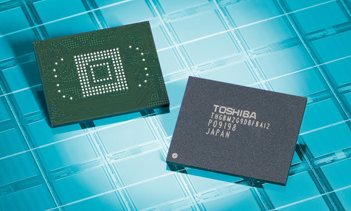
Toshiba said its new 64GB chip offers up to 1,070 hours of music at 128Kbps,8.3 hours of full-spec high definition video, and 19.2 hours of standard definition video. The individual 32Gbit chips are said to be 30 micrometers thick, giving them the highest density of NAND flash in the industry.
Mobile phone sales down in 2009, Chrome barely edges Safari
Overall mobile phone sales are predicted to be down from 2008; the Android Market now has 20,000 applications; and the recent release of Google Chrome beta helped give the browser a slight lead over Safari in market share.
Details on Intel’s potential Mac Pro 6-core i7 processor leaked
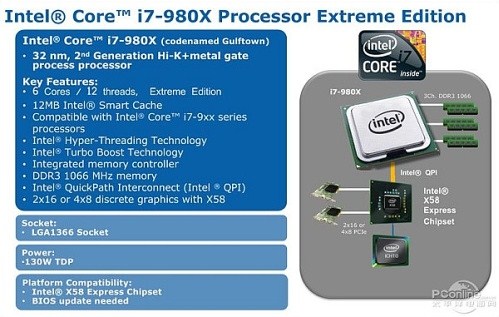
Intel’s forthcoming "Gulftown" 32nm, six-core processor will be known as the Core i7-980X and could be a part of new Mac Pro systems from Apple in early 2010.
Contrary to earlier reports, the new processors will not adopt the Core i9 name, and will allegedly keep the Core i7 title, according to leaked information relayed by Hardmac, the English-language version of French Apple site MacBidouille. The new processor, code-named "Gulftown" will fall under the i7 "Extreme Edition" category, the first of which will be the i7-980X.
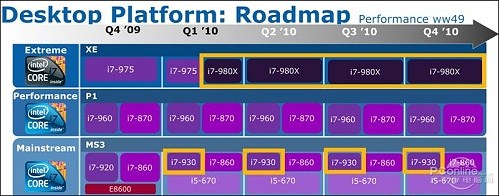
The alleged roadmap from Intel shows that the processor will clock in at 3.33GHz. That chip is expected to arrive in March 2010, but in the past, Apple has reached exclusive agreements with Intel to be the first to carry its new processors.
Previous reports have suggested Apple is testing the new Xeon chip, based on the Gulftown architecture, in its Mac Pro desktop. The new, upgraded processor features more horsepower and lower power consumption, and will be the first dual-socket, six-core processor for Intel.
The new 32 nanometer chips have 12MB of L3 cache, and six cores with 12 threads for each CPU. Apple usually doubles the processors in its high-end professional workstations, so it’s possible the new Mac Pro system could have a total of 12 cores and 24 threads. The new hardware could be released sometime in the first quarter of 2010.
The last major refresh to the Mac Pro equipped it with its Nehalem Xeon processors, with a high-end eight-core Mac Pro offering two 2.26GHz Quad-Core Intel Xeon 5500 chips. Earlier this month, Apple quietly upgraded that to a potential maximum 2.93GHz eight-core system.
Sketchy Evidence of iPhone 3.1.3 and iPhone 4.0 OS
BoyGenius points to some sketchy evidence found in their browser logs that seems to suggest iPhone OS 3.1.3 and 4.0 are being used in the wild.

The only information provided is an image containing references to both iPhone OS 3.1.3 and iPhone OS 4.0 which for the sake of clarity can be easily spoofed by adjusting a browsers user agent string.
Google issues custom unlocked phones ahead of rumored Jan. launch
Employees of Google were allegedly given brand new, HTC-made "Google Phones" this week: an unlocked, GSM-based handset sporting an OLED screen and running a new version of the Android mobile operating system.
Bolstering evidence of the rumored January 2010 launch, the phone is said to be capable of running on both T-Mobile and AT&T networks in the U.S. According to TechCrunch, the phone sports an internal Snapdragon chip and a high-resolution OLED screen inside a form factor thinner than an iPhone.
The phones were reportedly distributed to Google employees this week, and various workers began posting to Twitter about the hardware. One person who claimed to see the hardware firsthand described the Google Phone as "an iPhone on beautifying steroids."
The touchscreen device has no physical keyboard (only virtual), but offers a voice-to-text feature that allows users to dictate e-mails and notes aloud. The handset runs the unreleased Android 2.1 and features two microphones -- a second one on the back helps eliminate background noise. The report also said the hardware has a "weirdly" large camera.
Android 2.1 has new home screen visual enhancements that are said to add new features like animated desktop wallpaper. The hardware also includes a trackball for added control. It is said to be a tweaked version of the HTC Passion, pictured here:
Google also indirectly confirmed the distribution of the hardware on its official mobile blog, noting that the company was "dogfooding" a new product by testing it with its employees. No specific details on the hardware were officially provided from Google.
"We recently came up with the concept of a mobile lab, which is a device that combines innovative hardware from a partner with software that runs on Android to experiment with new mobile features and capabilities, and we shared this device with Google employees across the globe," Mario Queiroz, vice president of Product Management at Google said on the blog. "This means they get to test out a new technology and help improve it."
Previous reports had said Google worked closely with HTC to design all aspects of the hardware on the Google Phone. With numerous reports of a January 2010 launch, it’s likely something could be made official by the CES conference, which begins Jan. 7.