24 Examples of Web 2.0 and Traditional Design Rules Coming Together
21. Andrew Bradshaw
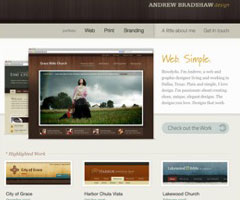
This is perhaps one of the most sophisticated sites on the list. Andrew has a great way of meshing texture, type, buttons, and photography into a congealed package. He also keeps hierarchy in mind, accentuating the important aspects and minimizing the sections that may not be of interest to all users.
The navigation is a highlight, with varying colors appearing as you hover over the tabs; a very sleek touch.
Also of note is the textured header and the strong font choice used in his logo. Again, Andrew combines subtlety and accents to create a beautiful site that is thorough and compelling throughout.
Traditional Aspects:
- Overall appeal of clean sophistication.
- Good use of accent elements, both in color and with type.
- As usual, a strong grid system holds it together.
- Hierarchy is implemented well.
Web 2.0 Enhancements:
- A different take on buttons.
- Brilliant use of photography and image presentation.
- Awesome details in the navigation.
22. James Lai
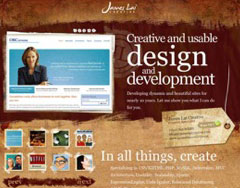
We commend him for the most is his ability to keep his site to a single page, We place a high value on the human element, sometimes the work speaks for itself, and We can’t fault a guy for believing in his own skill set.
Traditional Aspects:
- Simple, single-page solution.
- Animation adds interest to the presentation (though it slowed the site a bit on my end).
- Good attention to detail.
Web 2.0 Enhancements:
- Huge type on the homepage tells you the exact purpose behind the site.
- Contact information is easy to find.
- Cool thumbnails help users navigate the portfolio.
- Interesting use of texture.
23. Subvert
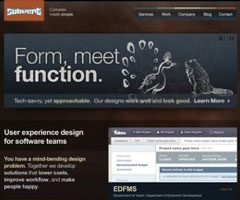
Subvert was included not only for its obviously functional layout, but for the fading slideshow featured on the homepage. The presentation is fun, but it’s also informative and valuable to potential clients.
The background texture is complimented by transparent details, including a great navigation system featuring transparent tabs! The hover status of this navigation is subtle and maintains the transparency.
Subvert doesn’t disappoint in its presentation. The grid structure is strong and easy to navigate, and upon clicking, the user is taken to an expanded view of the work.
Traditional Aspects:
- Great overall flow.
- Strong presentation of the portfolio on the “Work” page.
Web 2.0 Enhancements:
- Huge type presented on a fading slideshow.
- Transparent navigational tabs!
- The buttons are nice and add a good contrast to the backgrounds.
- Slideshow of the office on the “Company” page is a nice touch.
- Embraces technology.
24. Yellow Bird Project
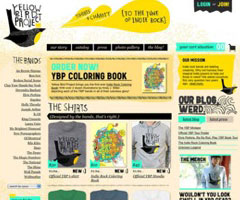
If you check out the Photo Gallery, you’ll see a slew of amateur photos that once again add to the Indie look, while showcasing the product.
This sort of underground approach, which was made popular by sites like threadless.com, immediately attaches the viewer to the product.
They want to be a part of the crowd and don’t feel as though someone is just trying to sell them something. If that isn’t a Web 2.0 philosophy, I’m not sure what is.
Traditional Aspects:
- Crafty logo really establishes the feel, which is carried out throughout the entire site.
- Though it feels scattered or loose at first, one realizes that this “put together” look is exactly what the designers were going for. They pull off the look while still making the site easy to navigate.
- Consistent, non-traditional approach.
Web 2.0 Enhancements:
- It’s more about the philosophy with this one. While the social aspect of Web 2.0 is in full effect, this site is also made strong because of its viral marketing approach and great underlying philanthropy.
- Builds a community!
- Great photos and easy navigation don’t hurt either.
In Closing…
Web 2.0 is a tough standard to define, as where traditional design standards are a rigid collection of rules and guidelines (grid structure, color theory, letter spacing, kerning, tracking, and so on), Web 2.0, while containing similar standards, is almost more so a way of life.
It combines philosophy, marketing, technology, ease of use, and countless other aspects of our busy universe with an ultimate goal of making things easier for the masses.
In that regard, Web 2.0 and the traditional rules that were established ages ago, ultimately share the same goal: To organize the chaos, and to simplify the complex.