The Art of Branding Yourself and Your Freelancing Business
Just as it is for big corporations, successful branding is essential to the success of a freelancing business and to just one self-employed web worker. It is often times overlooked, most likely because many don’t realize the large benefits that can come from it.
6. Write an Elevator Pitch
An elevator pitch is traditionally used offline when trying to sell your services in about 30 seconds or less.
Pre-planning a small speech to sell your stuff can help to include everything you need to, while still having a crafted pitch that is likely to sell.
However, as the technologies of web work expand each year, elevator pitches are becoming increasingly important for online freelancers as well.
An elevator pitch is very much a part of a brand. What is said in the pitch shares what you do, what your business does, and what you and your business can do for the person reading or hearing your pitch.
When a prospect asks what you do, you should not respond with, “I’m a freelance web designer” or “I’m a freelance writer”. Instead, this is a chance to say, in about 15-30 seconds, what you do in detail.
Nobody is interested in a “freelance web designer”, “freelance web developer” or a “freelance writer”.
What potential clients are interested in is “a web designer that focuses primarily on user-centric web designs that are both creative and professional” or “a web developer that creates website apps focused around users needs — apps that are designed to sell”.

Realistically, elevator pitches should be even better than the above. Furthermore, they can be used as an introduction to a portfolio, or used on the about page to help make sales there, too. To find out more about elevator pitches and how to write the perfect pitch, check out the resources below.
Further Resources
- Is Your Elevator Pitch a Home Run?
- The Writer’s Elevator Pitch
- Not Getting a Rise out of your Elevator Speech?
- Write an Elevator Pitch for Your Blog
- Elevator Pitch 101 – Intro To Writing a 30 Second Elevator Pitch
7. Write an About Page
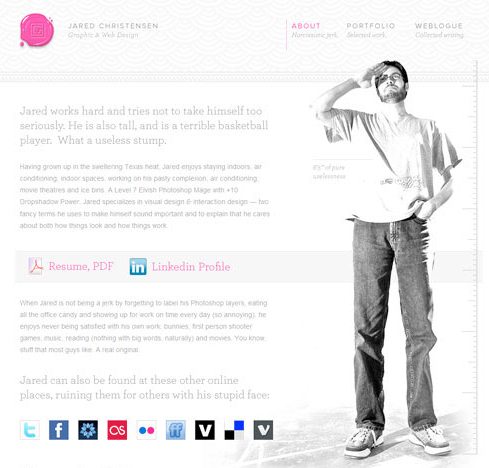
Your about page is where clients and others who may want to work with you can get to know you, before having to make any sort of contact. It should reflect yourself, and the way you do business.
Is your brand fun, professional or to-the-point? Most likely, your brand so far has reflected your personality in its own sense already. It’s now up to you to write an about page that can “make the sale“.
If a person has become interested enough to check out the about page, you have somehow convinced them to become at least half-way interested in your services.
Hopefully, you’ve attracted the right person based from your declared target audience. If so, how would you talk to this person?
Content-wise, you’re going to want to keep to your original style. For example, if you want a more company-like approach, write more formally. For a more creative approach, be personable and fun.
Your career choice as a freelancer and the work you do probably already reflects your personality a great deal, so just being yourself is the best option when trying to find a writing style for the about page.
It is of utmost importance to not try to sound like anyone else — your own voice is what makes you different from every other freelancer on the planet.
After figuring in the writing style and how to approach the page, one must outline what to include. Below is a minimum:
- Your history in the field and what you do.
- Your professional experience, and possibly school experience if present.
(A written résumé) - Perhaps a link to a more formal resume.
- Contact information, or a link to the contact page.
- A relevant note to their problem, and how you can help them.
(They need a website, you can make one for them.)
One may want to include other sections that further define their personality and business.
The more a potential client feels they know you, the more likely they’ll be to make contact because you and your business will seem more approachable. (Keep in mind though that it need not be a 10 page autobiography!)
Further Resources
- Your About Page Is a Robot
- How to Write Your “About Me” Page
- The 4 Essential Elements of an About Me Page
- Best Practices For Effective Design Of “About me”-Pages
- Five Tips (and a Bonus!) on How to Write a Fantastic About Page
- The Importance Of An “About Me” Page
8. Get Clients to Reach You
Now that you have a brand, it’s all about marketing and having clients find you.
You’ve created a target audience, identified business goals (both present and future goals), built the brand in a design sense around those two definition, and created content that helps sell your material.
This is all great, but at this point your brand is unknown and inactive. Don’t worry though — your brand is supposed to do the work for you, and given the time, it will.
Let people know about your brand by getting listed on job websites, doing guest posts, or leaving messages in forums. Generally, marketing is the same — but now you must market your brand as opposed to yourself.
Keeping Consistent
In my own experiences with branding, I’ve found myself re-branding and trying out new things.
It all came down to the fact that I had never taken the time to correctly brand my business, and specifically, that I had never taken the time to find my true target audience.
That forced me to revamp my brand to meet my needs as time went on. I could have avoided the whole mess if I would have taken the time in the beginning.
In the end, that has hurt my business because clients, readers, and other people that keep my business alive didn’t recognize me and my business after each revamp, and it also hurt my credibility.
It is essential to keep a brand consistent, for the reasons mentioned above, and for a number of other reasons. Once you lose the brand, you lose all of the benefits that come along with it. If you change a brand, even if it is being changes to better match goals today, it will have to start marketing from base zero once again.
Here are a few articles and tips on how to keep a brand consistent.
- Keeping Your Brand Consistent
- Is your online brand consistent?
- Keep Things Consistent – Basic Brand Management
Updating a Brand
As we change as professionals and as people, there is no doubt that we will want to change our brand too. We may grow into a design firm rather than a freelance web designer, or a web developer more so than a designer.
Much of the time a person will be focusing on one area of web work, only to find over time that their skill set and interests have expanded into something completely different.
- That’s fine; that’s life — we live, we grow, we change.
- The trick now is to not change your brand, but to upgrade it, and develop it further.
This is where our initial goals step into place. With the correct planning of our goals in the first place, we were able to plan ahead for moving forward. Perhaps you were a single, lonely freelancer back in the day you created your brand, but now you’ve finally got a team together as a firm, just as one of your goals stated. If you planned the brand around that goal successfully, you may only need to make a few tweaks, while still making your brand recognizable and overall, the same. - To upgrade a brand, keep a few things consistent: the name, the style, and the main color combination.
The name is the most recognizable part of a brand, so that is something you will never want to change. The overall style is very tightly knit into your target audience, and in order to keep your current client base, you’ll want to keep that. Lastly, color is one of the most memorable aspects visually, and most likely is the driving force visual for your brand. Keep this, and you keep the tone and memorable factor of your brand.
Further Resources
- How to Get Clients to Come to You
- 8 Brilliant Freelance Job Boards to Help You Get More Clients
- Getting the Freelance Gigs to Come to You — Your Resume and Portfolio
Wrapping Up
Brand creation is definitely an art in itself, and takes a lot of time to plan.
Don’t rush through this essential step of a freelancing career — having a brand can not only benefit you as a web professional, but also avoid fallbacks and can aid as a form of security.
No matter how big your business is — how big your client base, your team, or your popularity is — develop a plan, a brand around it if you haven’t already.
Then, stick to it, be consistent. It may also be helpful to take a step back if you already have a brand to analyze it. Can it be upgraded or further developed? Are you missing anything essential to your brand thus far?
There are, of course, many more tips and suggestion that could be mentioned, and much of it is a matter of personal experiences.
Author: Kayla Knight